
The Silent Store-Killer: Understanding and Mitigating Layer 7 DDoS Attacks on Magento Websites
For e-commerce merchants running on Magento (Adobe Commerce), the nightmare scenario is a site crash during peak shopping hours. Most retail business owners associate Denial of Service (DDoS) attacks with massive traffic spikes that flood network pipelines—the digital equivalent of a highway traffic jam.
However, there is a far more sophisticated, stealthy, and devastating class of assault: Layer 7 DDoS attacks.
Unlike traditional volumetric attacks that target network infrastructure, Layer 7 (Application Layer) attacks mimic legitimate human shoppers to exploit how Magento processes data. Because Magento is a feature-rich, highly complex enterprise platform, a surprisingly low volume of malicious application requests can completely cripple an online store.
Here is a deep dive into what Layer 7 DDoS attacks are, why Magento is a prime target, and how you can protect your digital storefront.
What is a Layer 7 DDoS Attack?
To understand a Layer 7 attack, it helps to look at the Open Systems Interconnection (OSI) model, which standardizes network communications into seven layers.
Layers 3 and 4 (Network and Transport Layers): Volumetric attacks (like UDP or SYN floods) strike here. They attempt to saturate your internet bandwidth by throwing massive amounts of raw, garbage data at your server.
Layer 7 (Application Layer): This is the top layer where human interactions occur—where HTTP requests are made, web pages are rendered, and API calls are executed.
A Layer 7 DDoS attack does not try to flood your network pipe. Instead, it sends seemingly legitimate HTTP/HTTPS requests directly to your web application server (Nginx or Apache). The goal is to exhaust server resources—specifically CPU processing power, system memory (RAM), and database connection pools.
Think of a Layer 3 attack as thousands of people blocking the front door of a restaurant so real customers can't get in. A Layer 7 attack is like thousands of fake customers filling every table inside the restaurant, ordering the most complex meal on the menu, and then walking out without paying. To the outside observer, the restaurant looks busy with real patrons, but the kitchen is completely overwhelmed and unable to serve actual paying guests.
Why Magento Websites Are Highly Vulnerable
Magento is a masterpiece of e-commerce engineering, offering unmatched flexibility, layered navigation, and dynamic catalog management. However, that architectural complexity requires an immense amount of backend computing power. Every time a page is not loaded from a cache, Magento must execute PHP code, query a MySQL/MariaDB database, run indexing logic, and compile a layout.
Attackers exploit this "resource asymmetry." It costs an attacker almost nothing to send a tiny HTTP request, but it costs your Magento server massive computational effort to answer it.
Malicious bots deliberately target the most resource-intensive endpoints on a Magento storefront:
1. Catalog Search Overloads (/catalogsearch/result/)
The Magento search bar is a frequent vector for Layer 7 attacks. When a user submits a search query, the system must scan thousands of SKUs, attributes, and text fields. Attackers script bots to flood the /catalogsearch/result/?q= endpoint with randomized, complex strings. Because the search strings are unique every time, Magento cannot serve the result from a cache; it must run heavy database full-text queries repeatedly, exhausting MySQL connection pools in seconds.
2. Layered Navigation Abuse
Layered navigation allows customers to filter products by size, price, color, and custom attributes. Each combination requires complex database sorting and calculation. Attackers send floods of requests with convoluted, multi-attribute filter parameters (e.g., ?color=12&size=15&price=100-200&manufacturer=34). Compounding these queries across hundreds of bot threads forces Magento’s database to its knees.
3. Customer Authentication and Password Hashing (/customer/account/loginPost/)
To protect user data, Magento uses highly secure, processor-heavy cryptographic algorithms (like Argon2id or bcrypt) to hash passwords during login attempts. While this keeps passwords safe, it requires substantial CPU cycles. Bots targeting the login or registration endpoints can quickly spike server CPU usage to 100%, causing the entire website to freeze.
4. Cart Creation and Checkout Exploitation
Creating a guest cart, adding items to a cart, and initiating checkout are inherently uncacheable actions. They require database read/write actions, inventory checks, and shipping/tax calculations. A coordinated Layer 7 attack targeting the checkout funnel can cause immediate database row locks, stopping actual buyers from completing transactions.

Beyond Downtime: Secondary E-Commerce Bot Attacks
While traditional DDoS attacks aim for complete site downtime, Layer 7 e-commerce bot traffic often shifts into more insidious forms of exploitation:
Card Testing (Velocity Attacks): Cybercriminals use automated bots to test thousands of stolen credit cards on a Magento checkout page. This not only consumes server resources but can result in massive transaction fees from payment gateways and potential merchant account suspension.
Inventory Hoarding: Bots flood your site to add limited-availability or high-demand items to their shopping carts. In Magento, this can hold inventory and mark items as "out of stock," preventing real customers from purchasing them and destroying sales velocity.
Aggressive Content Scraping: Competitors or malicious actors use scraper bots to extract pricing and product catalog data. If left unchecked, the shear density of the scraping traffic mirrors a slow-drip Layer 7 DDoS attack, degrading performance for legitimate shoppers.
Strategies for Defending Your Magento Store
Because Layer 7 attacks look exactly like real customer traffic, standard network-level firewalls (which look at raw data packets) will completely miss them. Mitigating these attacks requires an application-aware, multi-tiered security defense.
1. Deploy an Enterprise Web Application Firewall (WAF)
A WAF sits between the internet and your Magento origin server, acting as an intelligent shield. Modern WAFs, like Cloudflare or Fastly (which powers Adobe Commerce Cloud infrastructure), utilize behavioral analytics and threat intelligence networks to spot malicious bots. They analyze incoming headers, SSL handshakes, and request rates to block bad actors at the network edge before they ever touch your hosting environment.
2. Implement Granular Rate Limiting
Rate limiting restricts the number of actions a single user (IP address or session) can perform within a set timeframe. You should configure strict rate-limiting rules tailored explicitly for Magento’s high-resource URL patterns. For example, a real human rarely performs more than 5 catalog searches or 3 login attempts within a 60-second window. Anyone exceeding those thresholds should be automatically challenged or blocked.
3. Enforce Full-Page Caching and Edge Delivery
The best way to survive a Layer 7 flood is to prevent the traffic from hitting PHP and MySQL. Ensure that Full-Page Caching (FPC) via Varnish or a CDN edge is perfectly configured. If an attacker floods a standard CMS or category page, your edge cache can serve the pre-rendered HTML infinitely without putting any strain on your origin server.
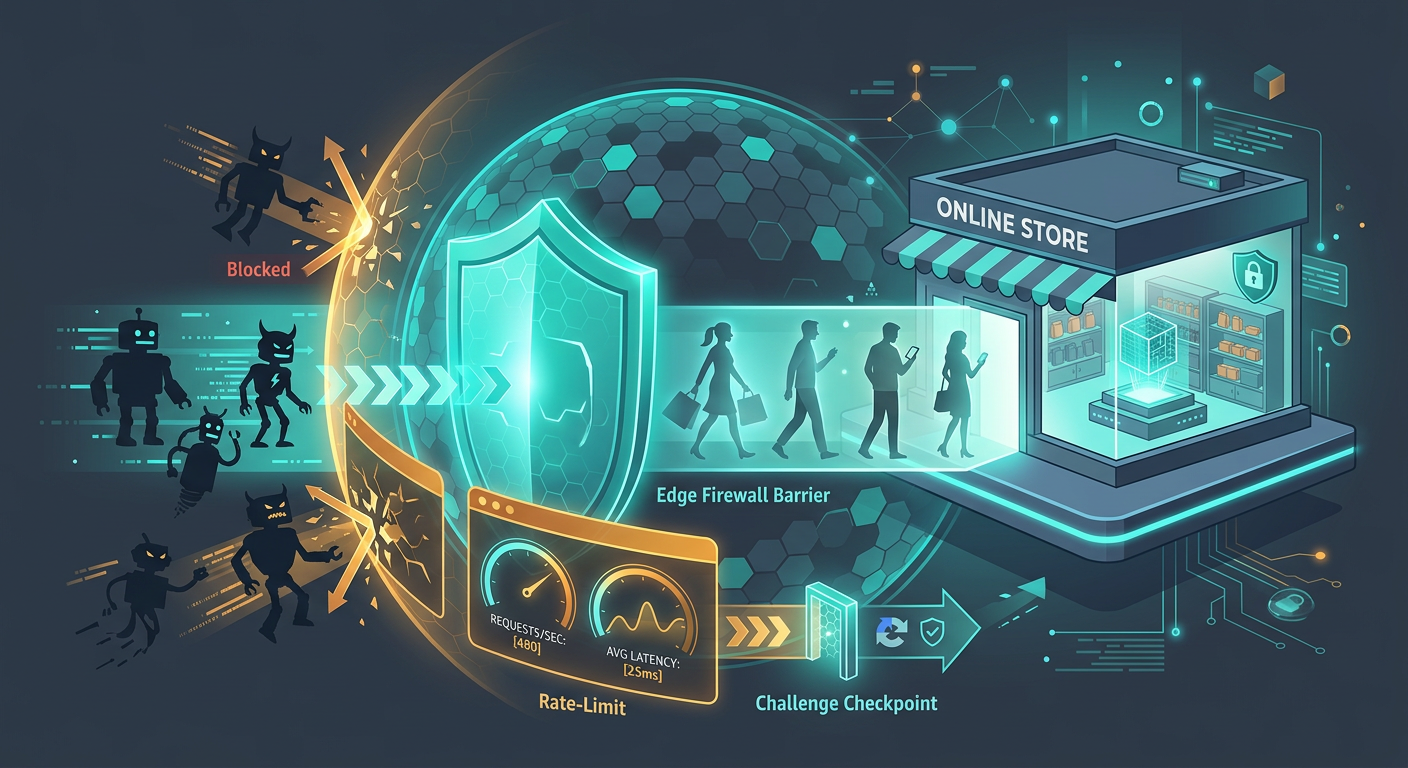
4. Deploy Smart Challenge-Response Mechanisms
Instead of using frustrating, old-school text CAPTCHAs that ruin the user experience, implement invisible, managed challenges (like Cloudflare Turnstile or Google reCAPTCHA v3). These systems score user behavior invisibly. If a request looks suspicious (such as typing at superhuman speeds or lacking human mouse movements), the system forces a challenge, stopping bots dead in their tracks.
Conclusion
Layer 7 DDoS attacks represent a silent, precise threat to Magento stores. They don’t need a massive pipeline of traffic to take your business offline; they just need to find the right, uncacheable endpoint and exploit it.
As a Magento merchant, relying purely on powerful hosting is no longer enough. Protecting your revenue, server performance, and customer experience requires a proactive, layered defense system that keeps malicious bots at bay while letting real shoppers seamless pass through to checkout.